


- Details
- By Native StoryLab
- Sponsored Storytelling
Sponsored Storytelling. In a packed conference room filled with nearly 150 attendees — boots and jeans, cowboy hats and notebooks — tribal leaders, ranch managers and agriculture professionals gathered for two days of technical briefings and candid discussion. The 2026 CKP PRF Tribal Summit brought them together, but the larger message extended well beyond livestock.
Across sessions on biosecurity, risk management, genetics, grazing and youth leadership, a consistent theme emerged: tribal agriculture is no longer just about production. It is about governance, capital strategy and long-term stewardship of land and resources.
[Download a PDF of the Tribal Summit report, plus 5 takeaways for tribal councils]
Opening the summit, CKP Insurance President Chuck Hemphill reminded attendees that the event was designed as a forum for collaboration, not a sales pitch. That tone held throughout. Presentations were followed by extended questions from tribal council members, natural resources staff and producers, often focused on implementation rather than theory. In several sessions, questions ran long enough to delay breaks and lunch, yet few appeared eager to leave.
Day One traced a path from biosecurity and land pressures to the practical work of building tribal capacity — workforce, processing and value retention — in Native livestock systems.
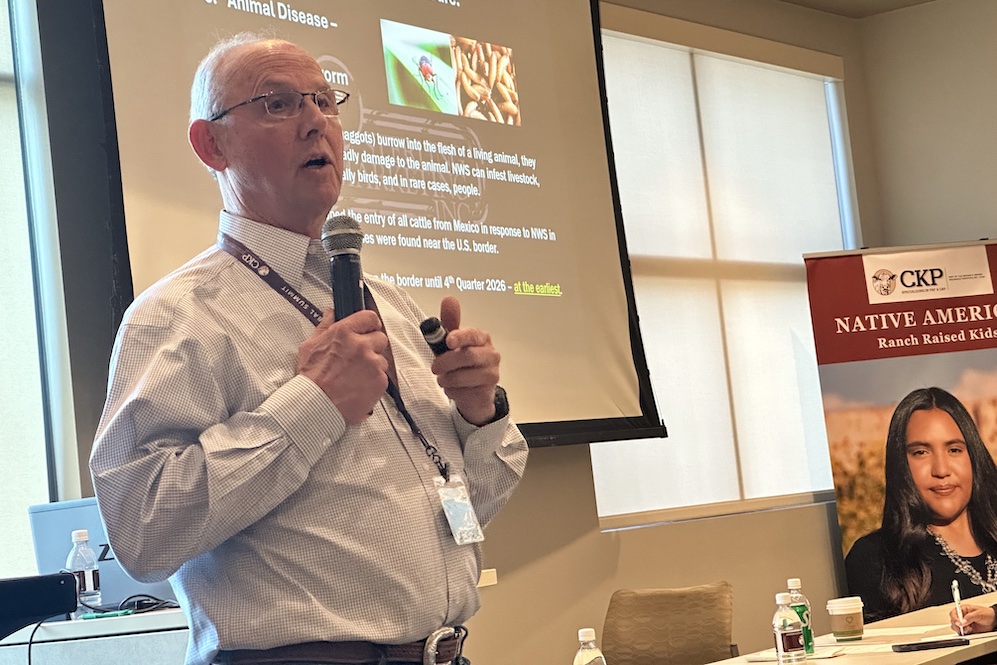
Dr. Phillip Kaufman of Texas A&M AgriLife briefed attendees on the spread of the New World screwworm in Mexico and federal efforts to prevent its re-entry into the United States. The session stretched nearly two hours, with tribal leaders pressing Kaufman on surveillance timelines, livestock movement and response protocols. For tribes with cattle, buffalo and sheep operations, early detection and reporting could determine whether herds — and revenue — are protected or disrupted.
A subsequent session on managing non-native horse populations addressed ecological degradation and tribal authority. Dr. Tolani Francisco, a veterinarian and enrolled member of the Laguna Pueblo, emphasized that the 1971 Wild Free-Roaming Horses and Burros Act does not apply to tribal lands, underscoring tribal authority to determine management approaches. The discussion turned quickly to enforcement of tribal codes and the political will required to act.
In the afternoon, Chris White Eagle of Sacred Storm Buffalo in Rapid City, S.D., described a workforce development program aimed at helping homeless youth, individuals in recovery and other young people from nearby reservations reconnect with purpose through hands-on ranch work. The program blends cultural reconnection with practical training in animal care, fencing and herd management.
“It’s more than a job — it’s a way of life,” White Eagle, an enrolled member of the Cheyenne River Sioux, said in describing a program designed not only to raise buffalo but to raise people and create pathways into agriculture, food production and tribal enterprise.
Later in the afternoon, butcher and meat scientist Sierra Anthony led a hands-on demonstration focused on value retention. Working through how a beef carcass is broken down, she showed where margin is gained — or quietly lost — depending on how cuts are separated and trimmed.
At one point she joked about her “BFK” — her “Big Fantastic Knife” — drawing laughter before pivoting back to fabrication economics. The message was direct: disciplined cutting practices and attention to trim loss can determine whether tribes capture additional value in processing or leave dollars on the table. Attendees asked detailed questions about labor, equipment and market outlets, underscoring the financial implications for tribal enterprises.
Day Two shifted from risk management to capital strategy and enterprise execution.
Leo Watchman, a former Navajo Nation agriculture administrator, reflected on securing tribal participation in the USDA’s Pasture, Rangeland and Forage (PRF) insurance program. By linking PRF indemnity payments to agriculture infrastructure funds, some tribes have created structured reinvestment pools for water systems, fencing and herd improvements. Colville Business Council Chairman Roger Finley referenced revenue his tribe generated over the past two years, framing the program as a capital tool when managed strategically. Watchman urged tribal leaders to treat such dollars as strategic capital rather than windfalls. “My definition of budget is a plan to spend,” he said. After delivering the line, he paused and looked around the room as several attendees wrote it down.
Dr. Sydney Reese of Prime Pursuits discussed genetic improvement and supply chain alignment in a historically tight cattle market. With U.S. cattle inventory near multi-decade lows, she noted that producers who document herd performance and maintain uniformity can position calves for premiums in aligned beef programs. Access to carcass feedback and performance data — information many tribal operations historically have not tracked — can materially affect revenue.
A session on “Capturing Value on Sale Day” highlighted how vaccination protocols, preconditioning and consistent weight classes influence auction outcomes. For tribal enterprises, the connection between management discipline and revenue stability was clear.
The final panel addressed land reclamation and stewardship. Dr. Zach McFarland of Cal Poly described efforts to balance grazing, cultural preservation and access to ancestral lands, including GIS mapping and virtual fencing technologies. The discussion reinforced that modern tools can support long-term land health when aligned with cultural priorities.
Professional bull rider Dakota Louis closed the summit with reflections on resilience and accountability, themes that echoed throughout the program.
Between sessions and in hallway conversations, tribal leaders compared notes on structuring agriculture infrastructure funds, enforcing grazing codes and coordinating between producers and tribal government. For many attendees, those exchanges were as valuable as the formal presentations.
For tribal councils and enterprise boards, the summit underscored a clear reality: agriculture decisions made at the council table shape revenue stability, land health and long-term sovereignty. Risk management programs such as PRF and Livestock Risk Protection can reduce volatility, but only if leadership understands eligibility requirements and allocates funds strategically. Genetic improvement, processing capacity and land management policies require coordination across agriculture, finance and natural resources departments.
For council members who did not attend, the takeaway is straightforward. Agriculture on tribal lands is increasingly sophisticated and capital-intensive. Proactive planning — rather than reactive crisis response — will determine whether tribes capture opportunity or absorb volatility in the years ahead.
For more information about the 2026 Summit and future events, contact Gloria West, Native American Resource Director, at [email protected] or 602-560-3152.
DISCLOSURE: These articles are sponsored content created by Native Story Lab for CKP, part of the Brown & Brown Insurance Services Inc. team. It was created as part of a paid partnership and was not produced by the Tribal Business News editorial team.
+++++++++++++++++++++++++++++++++++++++++
5 Takeaways for Tribal Councils from the 2026 Summit
For tribal leaders who did not attend, the message from the two-day gathering was clear: agriculture decisions made at the council table shape revenue stability, land health and long-term sovereignty.
Risk management is a governance issue, not just an agriculture issue. From the New World screwworm briefing to discussions of PRF and Livestock Risk Protection, speakers emphasized preparation over reaction. Biosecurity planning and revenue protection tools can reduce volatility, but only if councils understand eligibility requirements and support consistent enrollment. Waiting until a crisis hits the herd — or the market — limits options.
Insurance dollars should be treated as capital, not windfalls. Several tribes described linking PRF indemnity payments to agriculture infrastructure funds for water systems, fencing and herd improvements. As one speaker put it, “My definition of budget is a plan to spend.” The takeaway: strategic allocation determines whether indemnities build long-term capacity or disappear into short-term operating costs.
Management discipline directly affects revenue. Genetics, vaccination protocols, uniformity and sale-day preparation are not minor details. They influence auction prices and access to premium markets. Councils overseeing cattle enterprises should ask whether their operations are tracking herd data, receiving carcass feedback and aligning with higher-value supply chains.
Processing and workforce capacity keep dollars on tribal lands. Without local processing infrastructure and trained workforce, tribes often export margin off-reservation. Sessions on buffalo workforce development and meat fabrication underscored that value retention depends on both skilled labor and enterprise planning.
Leadership engagement determines outcomes. Many of the strategies discussed require coordination across agriculture, finance, natural resources and enterprise boards. When council members understand the tools — and set clear policy direction — tribes are better positioned to stabilize revenue, protect land and strengthen sovereignty.
For more information about the 2026 Summit and future events, contact Gloria West, Native American Resource Director, at [email protected] or 602-560-3152.