- Details
- By Chez Oxendine
- Gaming
A push by federal regulators to classify sports betting as a financial product is drawing sharp opposition from tribes, who say it could undermine tribal gaming compacts and redirect billions in revenue.
The concern follows congressional testimony Wednesday by U.S. Commodity Futures Trading Commission Chairman Michael Selig, who signaled support for allowing federally regulated prediction markets to offer contracts tied to sports outcomes.
Tribal officials say the approach blurs the line between federally regulated “event contracts” and state-authorized sports bets, threatening decades of negotiated exclusivity under the Indian Gaming Regulatory Act.
In the House Agriculture Committee hearing, Selig described sports-related prediction markets as swaps governed by the Commodity Exchange Act — not wagers subject to state or tribal gaming law — a distinction tribal leaders rejected during a press call Wednesday ahead of the hearing.
“If the federal government decides these are commodities instead of bets, it wipes out the foundation of tribal exclusivity,” said Indian Gaming Association Chairman David Bean during a press call. “That’s not modernization — that’s erasure.”
Selig told lawmakers that prediction markets could “play a role in price discovery” and said he was open to expanding eligible event contracts.
Later in the hearing, Rep. Jim Costa (D‑Calif.) pushed back, saying the products “aren’t some new harmless financial product.”
“In too many cases it’s just gambling by another name,” Costa said, warning that betting on “sports, politics, in some cases even on war, instability and human suffering” undermines both public trust and tribal compacts.
Costa added that California’s 106 tribal governments depend on “carefully negotiated tribal‑state compacts,” and cautioned that the CFTC risks “looking less like a market regulator and more like a body giving permission for these platforms.”
When Selig responded that the agency was taking its authority seriously and had issued an advance notice of proposed rulemaking, Costa countered: “I don’t believe Congress intended for sports betting to be repackaged as a financial product to dodge rules that apply to everyone else — including our tribes.”
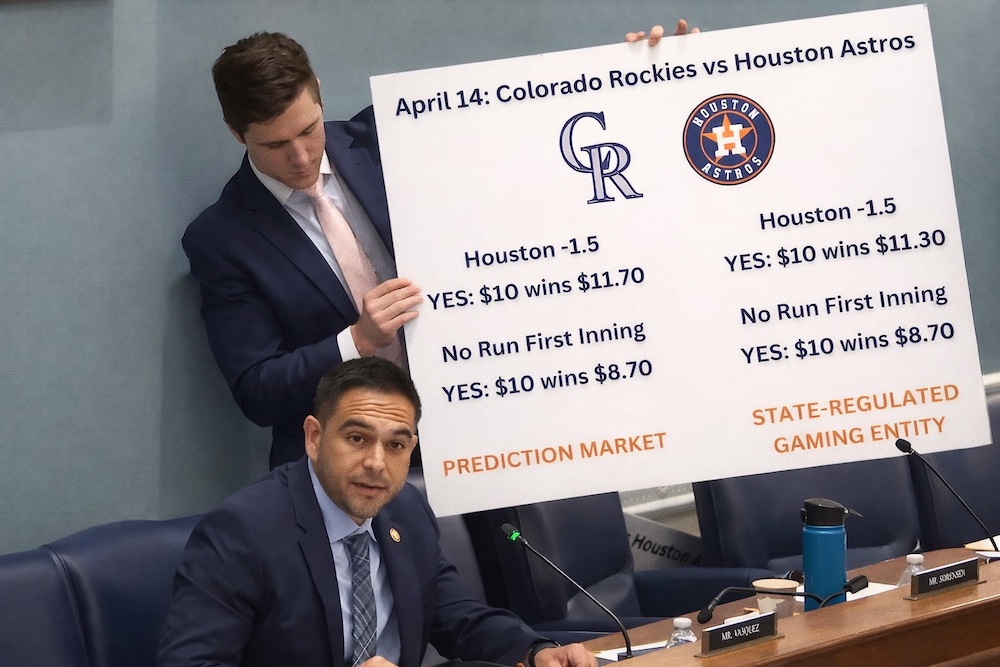
Rep. Gabe Vasquez (D‑N.M.) echoed those concerns, saying consumers “couldn’t care less if they were using an official sportsbook.”
“Tribes in my district have gone through decades‑long negotiations, agreements and settlements,” Vasquez said.
“When a federal agency allows prediction markets to bypass these longstanding requirements, it undermines tribal sovereignty and state protection.”
He cited the Pueblo of Laguna as one example of communities “losing out on vital revenue.”
When Selig replied that such markets could hedge risk and would remain under CFTC oversight, Vasquez pushed back.
“With all due respect, I don’t think this is hedging. This is a bet that’s clearly sports gambling. If this product looks like sports betting, the public should expect sports‑betting‑type protections and regulations,” Vasquez said. “At the end of the day, this comes down to a simple question: Are we regulating real economic risk, or are we allowing prediction markets to steal billions of dollars in an unregulated free-for-all as Congress and CFTC turns a blind eye?”
The CFTC’s written testimony and appendices go further, asserting that state gambling laws are preempted when applied to CFTC‑regulated event contracts. Enforcement Director David Miller warned that sports injury and player‑performance contracts pose “acute risks of manipulation and insider trading,” but framed those concerns as matters of market integrity — not gaming enforcement.
For tribal governments, that distinction is existential. If sports‑related prediction markets are treated as swaps rather than wagers, tribes lose both regulatory control and exclusivity, effectively sidelining state‑tribal compacts in favor of federal oversight.
“Prediction markets threaten these rural jobs and the progress that we’ve achieved by violating our laws, federal laws, and the laws of our state government partners,” Bean said. “Pull up your Kalshi app for one second, and you’ll see the same bets that are offered in every other legal sportsbook.”
The CFTC’s proposed rule on prediction markets, released March 12, would define the types of event contracts that designated contract markets may list. The agency opened a 45‑day comment period that has drawn hundreds of submissions from state regulators, academics, sports organizations, and tribal governments.
A media briefing prepared for the hearing said Congress “clearly wrote the CEA to prohibit contracts tied to gaming” and warned that federally approved sports contracts would “undermine state laws and regulatory systems nationwide.”
The briefing also noted that sports wagering is a state‑regulated activity under the Supreme Court’s 2018 Murphy v. NCAA decision.
California Nations Indian Gaming Association Chairman James Siva said Selig’s testimony reinforced fears that the CFTC is moving quickly without consulting tribes or states.
“There is no way around it. They can call these prediction markets. They can call them sports event contracts, but it is illegal sports betting with very little oversight,” Siva said. “This is (without) exaggeration, the largest and fastest‑moving threat our industry has ever seen in its 30 plus year existence.”