


- Details
- By Jamie Miller, Special to Tribal Business News
- Indigenous Entrepreneurs
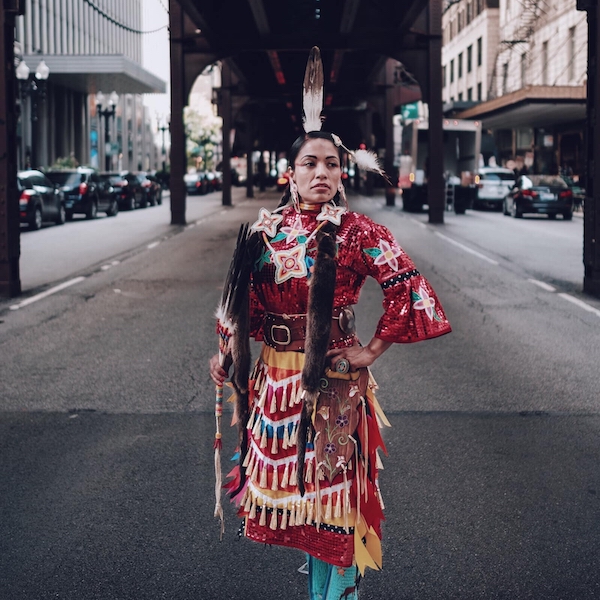
Starla Thompson’s career centers on healing — and how it shapes policy, advocacy and services for Native communities.
A Potawatomi woman who grew up in Chicago disconnected from her Native ancestry, Thompson entered the workforce as a young mother without a clear path. Her return to her community led her into work focused on missing and murdered Indigenous people (MMIP), tribal policy and survivor support.
She serves on a U.S. Department of Justice task force on violence against Native women and founded Walks With a Good Heart, LLC, which blends Indigenous knowledge with contemporary systems to support community healing and self-determination.
This conversation has been edited for clarity and brevity.
Can you tell a little bit about your career journey and the work you do now?
I was a young mother, and so school was never an option. No one ever talked to me about school — that seed was never planted.
I ended up talking to a friend who suggested going to college…I ended up getting an undergraduate degree in human resources and later went to the University of Chicago for a master’s degree in public policy.
I have always been an advocate for women because of my family’s experience but at some point it transcended into what we are seeing with our women — missing and murdered women and femicide.
I now work in advocacy and policy, advising tribal organizations and working with the Missing and Murdered Indigenous People (MMIP) and US Department of Justice’s Task Force on Research on Violence Against Indian and Alaska Native Women.
How does your ancestry tie to the work you do?
I come from a long line of Potawatomi from the Great Lakes. My grandmother was a boarding school survivor and my mother was stolen and illegally adopted as a child. We already had this history in our matriarchal lineage of bad policy and trauma.
But the land kind of always calls you back home. So when my mom was old enough, she came back to the Great Lakes. My grandmother stayed in Chicago and died there hoping she would come back. We have all this unsettled shame, guilt and trauma that we were carrying in matriarchal lineage. It has shaped the work that I do — and who I am as a mother, a woman and a professional.
I am my mother’s oldest daughter so I really felt it was my responsibility to reconnect our family and try to find a way out of all of that traumatic experience…first and foremost was the connection to our culture and getting back home. And I spent many years in my young adulthood doing that because that was what I knew would save us — that connection to healing.
What brought you to do the work you do?
I took different routes trying to understand who I was. I started working in the gaming industry and realized although I did not have a fire for gaming, I had a fire for people. I knew that I could identify with them and move them. I thought that meant I should go business school and get an HR degree, so I did…then I came back to gaming and realized that I wanted to work with my people. I wanted them to see something in themselves.
I started a leadership development program and created a pathway for individuals to pursue their dreams with support…the type of support I did not have. It considered cultural elements too and we met frequently to reconnect with that — asking questions like “Why are we really here? How do we operate in the business world with traditional values?”
It was very successful and was a huge turning point in my career — that was when I realized what I was good at and what I have to offer.
What is one thing in your career that you are proud of?
I started out on a journey to research and share the story of a Potowami woman named Kitihawa— wife of Jean Baptiste Point du Sable’s, the “first non-Native settler and founder of Chicago.” I knew instantly that story was about her and not him.
From what I understand, I am the first person to really research her in depth. I went to all the Potawatomi bands. All my sources were non-western resources and first-person perspectives — all relatives speaking on another relative. I did that research, I advised linguists and cultural keepers and elders, and her story started to unfold. Eventually, I do want to tell her story on a large scale, and want to share it publicly. I think that will be my life’s work.
What advice do you have for people looking to figure out what they want in their career?
I think it starts with healing. Healing has a really unique way of clearing out all the noise that you’ve accumulated over your life, allowing you to truly understand what your special talents are, because everyone has them.
As people, because we are still healing, we are looking for other things to fulfill us. I spun my wheels for years doing that and became even more despondent. It wasn’t until I got through this healing—for me that means sobriety, that means time in my community. I think that’s what we need to get to…once you do that, all the other things just come and you will see who you are.You’ll have a mirror up to yourself and be able to say, “This is who I am,” and move authentically.
In Service is a new recurring series that highlights Native executives in professional services — law, banking, accounting, consulting, nonprofits and related fields — who work with tribes, tribal enterprises and Indigenous entrepreneurs. Know someone who should be featured? Contact [email protected].