- Details
- By Brian Edwards
- Economic Development
WASHINGTON — After more than three decades of pressure from tribal governments seeking relief from IRS uncertainty, the U.S. Department of the Treasury and the Internal Revenue Service on Monday announced that two long-awaited tribal tax regulations have been finalized — a historic move tribal leaders say removes major barriers to economic development and self-governance in Indian Country.
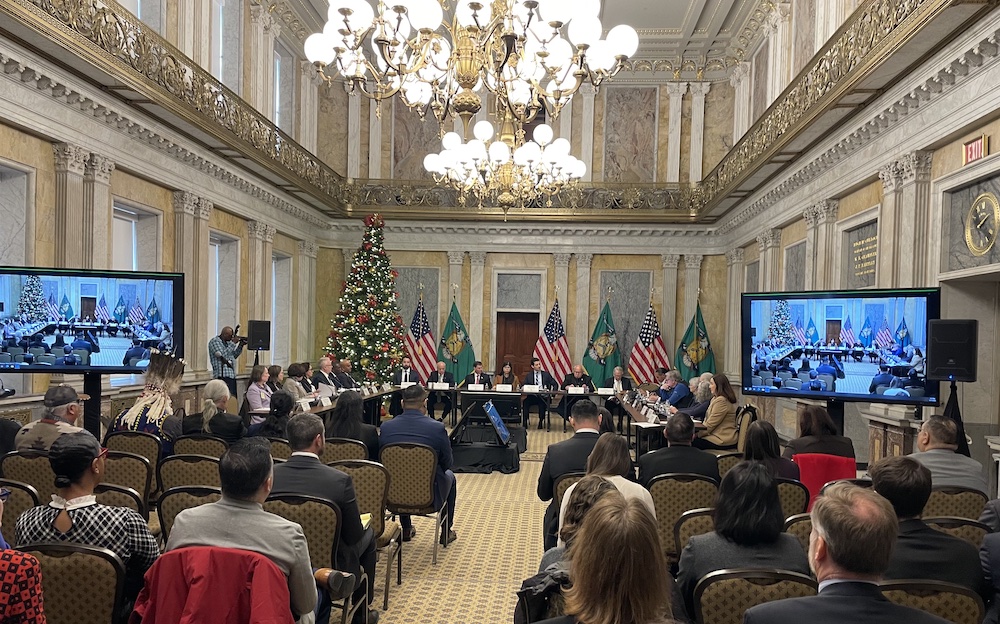
The rules were announced during a meeting of the Treasury Tribal Advisory Committee. Treasury officials and tribal leaders attending the meeting offered remarks on the rules and their implications for tribal governments and citizens.
 The rules address two areas tribes have long identified as sources of friction with federal tax authorities: the treatment of tribal general welfare programs and the federal income tax status of business entities wholly owned by tribes.
Taken together, the rules affect everyday tribal life and tribal economies — from housing, scholarships and emergency aid for individual citizens to how tribes finance, structure and grow tribally owned businesses that fund government services.
Tribal leaders said the lack of clear rules had forced tribes to over-comply, delay projects and structure business ventures defensively — increasing borrowing costs and limiting investment in tribal economies that rely heavily on commercial activity to fund government services.
The first rule implements the Tribal General Welfare Exclusion Act of 2014, confirming that benefits provided by tribal governments to their citizens may be excluded from federal income tax. Treasury officials said the final rule defers to tribal determinations of what constitutes general welfare under tribal laws, customs and traditions, rather than imposing rigid federal definitions.
Under the rule, tribes may fund general welfare programs using any revenue source, including gaming revenue, and may provide assistance ranging from housing and utilities to education support, emergency aid and small-business grants without triggering federal income tax for recipients. Tribal leaders said the clarification removes lingering fears of inconsistent enforcement that persisted for years after Congress enacted the law.
Treasury Secretary Scott Bessent framed the rule as part of the administration’s pro-growth and deregulatory agenda, saying in a statement that it reduces compliance costs and provides clearer guidance. Tribal leaders, however, emphasized that the significance lies in the federal government’s explicit recognition of tribal sovereignty in defining and delivering community support.
The second rule clarifies the tax treatment of business entities wholly owned by tribes and chartered under tribal law, confirming that those entities are treated as part of the tribal government and are not subject to federal income tax.
Treasury officials acknowledged that decades of uncertainty around the tax status of tribally owned corporations had impeded access to capital, raised financing costs and constrained investment opportunities for tribal enterprises that generate revenue for government services.
Derek Theuer, interim deputy secretary of the Treasury, said the final general welfare rule recognizes tribes’ sovereign authority to self-determine the needs of their communities, making clear that the IRS will defer to tribal judgments under tribal laws, customs, religions and traditions. “Our final rule makes clear that tribes know best the economic needs of their own communities,” Theuer said.
U.S. Treasurer Brandon Beach said the rule would allow tribes to “focus on growth rather than guessing the cost of financing,” pointing to the importance of tax certainty for investment and long-term economic planning.
The regulation allows tribes to rely on the rule for prior tax years and, in some cases, to seek refunds where federal income taxes were previously paid. Treasury officials said it also eliminates the need for the so-called “integral part” test, long criticized by tribes as vague and costly, and facilitates multi-tribe business structures so long as ownership remains entirely tribal.
W. Ron Allen, tribal chair and CEO of the Jamestown S’Klallam Tribe in Washington state and chair of the TTAC, said tribes had sought guidance on general welfare benefits for more than a decade and confirmation of the tax status of tribally owned businesses for roughly 30 years.
“This is something Indian Country has been working on for 30 years,” Allen said, describing the rules as a step toward strengthening tribal economies and reducing reliance on federal funding by allowing tribes to generate and deploy their own revenue on their own terms.
Allen and other TTAC members credited sustained tribal consultation — beginning with the creation of the committee during the first Trump administration and continuing through the current administration — with pushing the regulations across the finish line.
While tribal leaders praised the administration and Treasury staff for finalizing the rules, they also signaled that additional work remains.
Several tribal leaders urged the Treasury and the IRS to take up the tax treatment of partially owned tribal enterprises as a next step, noting that joint ventures and mixed-ownership structures are increasingly common in large-scale development projects. Allen and Rodney A. Butler, a TTAC member and chairman of the Mashantucket Pequot Tribal Nation in Connecticut, encouraged the federal government to pursue additional tribal consultation on the issue, but no specific future guidance or consultation process was announced during the meeting.
Tribal leaders also emphasized that successful implementation of the new regulations will depend on the capacity and placement of the IRS Office of Indian Tribal Governments (ITG). Will Micklin, fourth vice president of the Central Council of Tlingit and Haida Indian Tribes of Alaska, speaking on behalf of TTAC members, said tribes expect ITG to play a leading role in answering questions, resolving compliance issues and supporting the government-to-government administration of the rules. Micklin urged the IRS to ensure the office is fully resourced and properly positioned within the agency to carry out those responsibilities.
Tribal Business News previously reported that the IRS cut roughly half the staff of the ITG in March 2025 as part of a broader reduction of about 6,700 agency employees, raising concerns among tribal tax experts about the office’s capacity to support implementation of the newly finalized rules.
Several tribal leaders at the TTAC meeting cautioned that implementation of the new rules will be critical, particularly training IRS personnel to ensure consistent application of the rules. TTAC members also urged continued coordination with other federal agencies, including the Social Security Administration, on how tribal benefits are treated for purposes of SSI, Medicaid and other programs.
The final regulations are scheduled for publication in the Federal Register on Tuesday.
Levi Rickert contributed reporting.
To view more information on these rules, see the Treasury’s Tribal General Welfare Fact Sheet and Consultation and Federal Feedback Summary and itsTribal Entity Fact Sheet and Consultation and Federal Feedback Summary.