- Details
- By Brian Edwards
- Finance
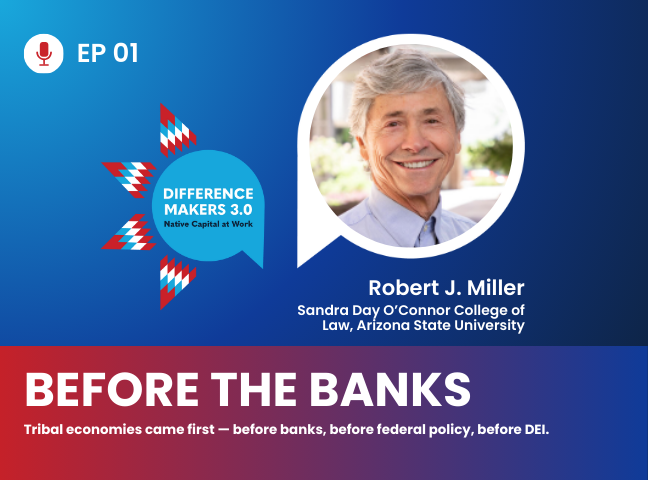
Talking with Robert J. Miller is a reminder of how much of American economic history has been misremembered — or deliberately forgotten.
The attorney, author and law professor, who is a citizen of the Eastern Shawnee Tribe, joined the first episode of Difference Makers 3.0 to help set the foundation for the season: Native communities did not begin on the margins of the economy. They were building, trading, governing and sustaining complex economies long before modern banks or federal policy existed.
Miller walked co-hosts Brian Edwards and Pete Upton through pre-colonial trade networks, systems of property and inheritance, treaty-making, and constitutional law — making a clear case that tribes are sovereign governments, not racial groups. That distinction, he argued, is essential to understanding why Native CDFIs are not DEI programs, but modern expressions of nation-building and self-determination. Here are a few highlights from the conversation.
On pre-colonial tribal economies:
“Indigenous people supported themselves for millennia before Europeans arrived. We did not wander around the woods waiting for apples to fall out of trees. There were great population centers and very active economies.”
On trade, currency, and private property:
“Everything except land was private property. People owned fishing sites, berry patches, farming plots — and passed them down through well-recognized rules of inheritance.”
On sovereignty and the Constitution:
“Our Founding Fathers understood tribes were governments — on par with foreign nations and the original states. That’s why the Constitution gives Congress authority to regulate commerce with Indian tribes.”
On why tribes are not DEI:
“This isn’t a racial definition — it’s a political one. These programs are based on citizenship in tribal governments, not race. That’s as far away from DEI as it can possibly be.”
On self-determination and modern Native finance:
“What the CDFI Fund is doing looks like treaty-making. It’s a government-to-government relationship — federal policy carried out in partnership with tribal nations.”
Episode 1 sets the stage for the rest of the season by grounding today’s Native CDFI movement in law, history and sovereignty. In Episode 2, Difference Makers 3.0 continues the story with researcher and economist Miriam Jorgensen, tracing how Native CDFIs emerged from decades of exclusion and became a national financial network.
Visit Difference Makers 3.0 to listen to the full episode and subscribe on your favorite podcast platform.